EZ Voice LLCEZ Voice LLC

The research

The gaps we found, and what we built for them

There are already AAC products. These are the gaps the published research shows in them, and how each gap shaped myEZvoice, EZspeak and EZbot. Every item is sourced and says how far it was checked.

How the research shaped EZ Voice

We did not set out to build a tablet.

  1. First

    A device for ages 12 and up, for those who had outgrown the tablet

    Our first goal was a device for ages 12 and up, for those who like Evan had outgrown the tablet: its visual cues, its structure and its tedious navigation. That became myEZvoice.

  2. Then

    The research showed the younger children needed something new too

    The more research we did, the more we saw a real need for younger children to have more modern visual cues and a different structure: sentence starters, rooms that hold the words for each daily activity, and pictures in those rooms that open boxes of words with the verbs along the side. That became EZspeak.

  3. And

    A bot for the child, the parents, and the child’s progress

    EZbot, designed to help the child, to help parents use the board at home, and to help us measure when a child is advancing, so the board can grow with them by skill and by age.


The case in three studies

The three we lean on most. Each was read in full: a CDC report, the Cochrane review, and the field’s own journal.

The need

1 in 31

eight-year-olds identified with autism in 2022, up from 1 in 68 in 2010.

CDC MMWR, 17 April 2025 Read in full · The studies

Read it carefully: these are children already identified by a provider, and CDC changed how it counts with the 2018 data, so the years are not a like-for-like count.

The gap

2 trials

The Cochrane review found only 2 randomized trials (154 children) for minimally verbal autistic children and rated the evidence “very low.” In the one AAC trial, “gains were not maintained 10 months later.”

Brignell et al. 2018, Cochrane Read in full · The studies

Read it carefully: a review of randomized trials, not of every study. Our own searches found no study that follows today’s AAC for 3 years or more.

The design

“Simply replicate”

Many AAC apps “simply replicate the approaches to representation and organization of vocabulary items seen with traditional AAC systems.” And phones “are socially valued; they are free of the stigma sometimes associated with the use of assistive technologies.”

McNaughton & Light 2013, pp. 108 and 113 Read in full · The studies

Read it carefully: written in 2013, about the apps of 2013. A view from the field’s leading researchers, not a measurement.

The gaps we identified in this market

Each one links to the studies behind it, says how far its source was checked, and what we built for it.

  1. No study found follows today’s AAC devices or apps for 3 years or more.

    The studies · Brignell et al. 2018, Cochrane Read in full; Romski & Sevcik 1996 Official record

    BuiltEZspeak: EZbot counts the words a child uses without help and proposes the next level; an adult approves. Progress inside the app, not a study over years.

  2. The research centered on young children. Teenagers’ needs “are quite different,” and “more research is urgently needed.”
    The studies · Holyfield et al. 2017 Official abstract

    BuiltmyEZvoice: made specifically for ages 12 and up.

  3. No AAC was found designed for the phone first. The leading apps on iPhone are the same app as on the iPad.

    The studies · Apple App Store records, 12 Oct 2026 Official record

    BuiltmyEZvoice: designed for a teenager’s own phone first: 9 to 12 large pictures to a screen.

  4. AAC displays were built on adults’ thinking, and researchers said they “should be redesigned.”

    The studies · Drager et al. 2003 Read in full

    BuiltEZspeak: new visual cues drawn for it, and rooms whose objects open boxes of words with the verbs along the side.

  5. Most AAC apps were “not research-based”; many “simply replicate” the older systems.

    The studies · McNaughton & Light 2013 Read in full

    BuiltBoth: started from the research and from Evan, not from an existing board.

  6. The adults around the child top the reasons devices are dropped.

    The studies · Johnson et al. 2006 Read in full

    BuiltEZspeak: EZbot’s “Show me” builds a sentence on the real buttons so a parent sees how the board is used, and the parent chooses how much EZbot helps. Not on the phone yet.

  7. Talking with AAC is far slower than speech: as low as 15 to 25 words a minute, against 150 to 250.

    The studies · AAC journal 2025 Read in full

    BuiltmyEZvoice: whole everyday phrases on one button: one tap says the sentence.

  8. No study found tests software as the one who models on the board.

    The studies · our searches; the modeling studies used people (O’Neill et al. 2018; Sennott et al. 2016) Official abstract

    A study we could runEZspeak: EZbot is software that models on the board. No study has tested that yet; EZ Voice could be the one to run it.

  9. No AAC product found offers Puerto Rican, Dominican or Cuban Spanish. The Spanish they name is Spain, US, Latin American or Mexican.

    The studies · App Store records for LAMP Words for Life and Proloquo2Go Official record; Tobii Dynavox TD Snap page; our searches, 12 Oct 2026

    In testingBoth: the tablet has the dialect setting for Mexican, Puerto Rican, Dominican and Cuban Spanish; on the phone, Cuban and Mexican Spanish are in testing. Every Spanish line is reviewed by native speakers before it is final.

1

Older kids and teenagers

myEZvoice

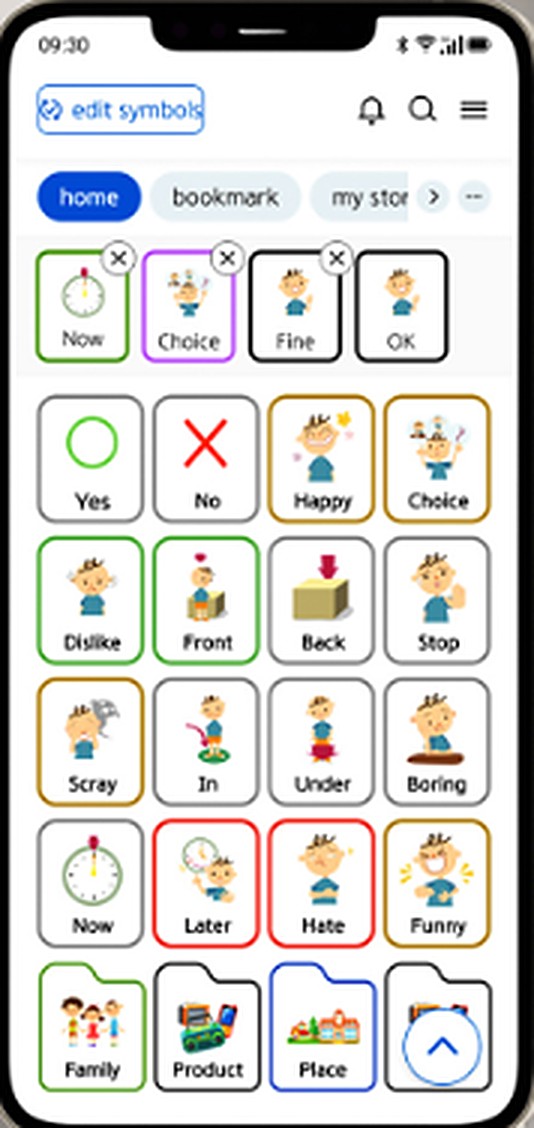
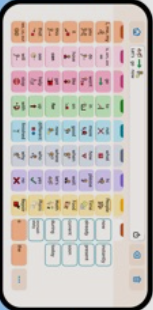
A current AAC app on a phone: rows of small single-word symbol buttons
Today: rated 4+
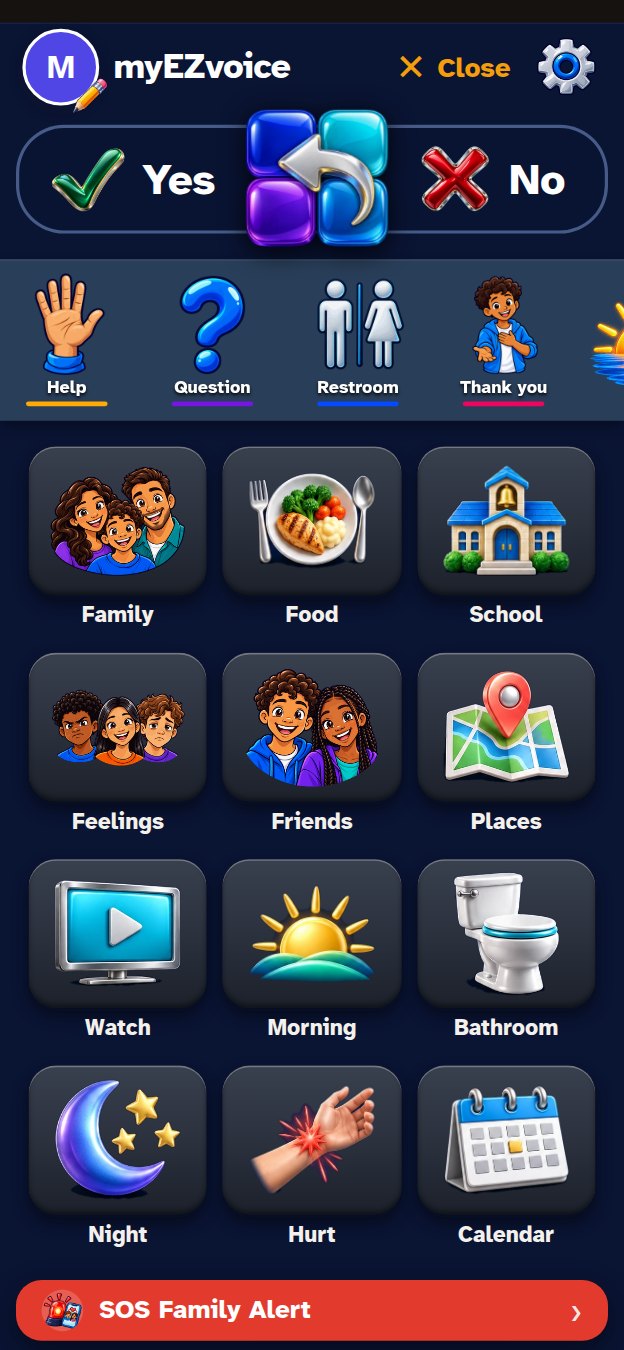
myEZvoice home screen
myEZvoice: 12 and up

Why we looked

Evan had outgrown the tablet: its visual cues, its structure, and the many screens it took to say something. We wanted to know what the research says about AAC for middle and high school students.

What we found

The research centered on young children. Researchers say teenagers’ needs “are quite different” and “more research is urgently needed.” Teenagers who use AAC need the right words, and how classmates see them matters.

How we applied it

myEZvoice is made specifically for ages 12 and up. The school day holds grade 7 to 12 classes, each with its own phrases, and the Sentence Builder has a High School topic. Every picture is the app’s own art.

  1. Teenagers fall between the child and adult research.

    “Much of augmentative and alternative communication (AAC) research for individuals with autism spectrum disorder has focused on young children.” For teens and adults, “more research is urgently needed.”

    Limit: about autism; the study count behind it is not in the abstract.

    Holyfield et al. 2017 Official abstract

  2. Teenagers who use AAC need the right words.

    Interventions for adolescents who use AAC should address “language needs, particularly vocabulary.”

    Limit: guidance, not a test of a vocabulary.

    Smith 2015 Official abstract

  3. How classmates see a teen who uses AAC matters.

    Of 136 adolescents, “girls were more positive than boys; and familiarity with peers with disabilities was associated with more positive attitudes.” Of 115 children aged 11 to 13, attitudes were more favourable when the device had voice output.

    Limit: typically developing raters watching videos.

    Beck et al. 2010 Official abstract · Lilienfeld & Alant 2001 Official abstract

  4. Child-style AAC can feel “infantilizing”.

    One participant: “Many AAC apps feel like they’re made for kids or students, and it feels infantilizing.”

    Limit: a preprint, 12 adults aged 18 to 44, not teens.

    Martin & Nagalakshmi Read in full

  • Where the evidence stops: no study found tests a vocabulary built for teenagers.
2

The phone

myEZvoice

Proloquo on a phone: a dense grid of small word buttons
Today: the tablet board, shrunk
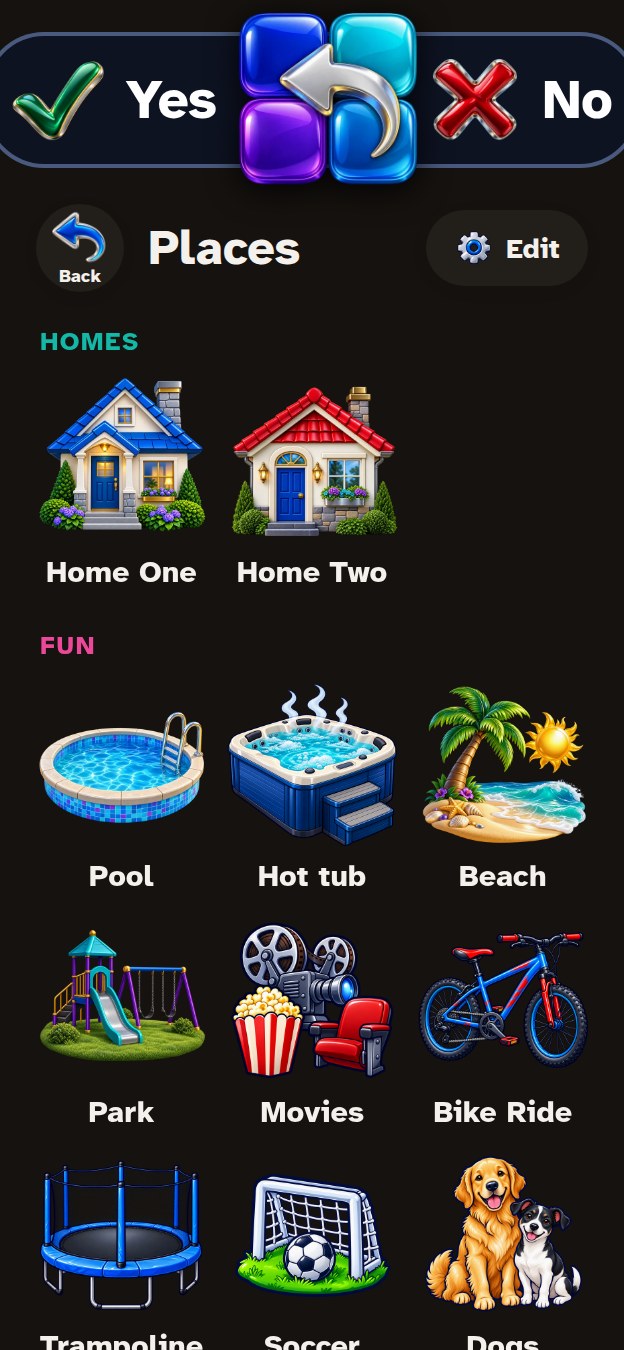
myEZvoice Places: large pictures for Home, Pool, Beach, Park, Movies and more
myEZvoice: made for the phone

Why we looked

Teenagers carry a phone, not a tablet. We looked for AAC designed for the phone.

What we found

Nearly every teen has a smartphone, and researchers say phones are free of the stigma of assistive devices. But the leading AAC apps on iPhone are the same app as on the iPad, and families use the iPad first and the phone second.

How we applied it

myEZvoice is designed for the phone first, for a teenager’s own phone: 9 to 12 large pictures to a screen.

  1. 95% of teens have or have access to a smartphone.

    US teens 13 to 17: 95% in fall 2024, the same in 2023 and 2022, up from 73% in 2014 to 2015. 1,391 teens surveyed.

    Limit: all teens, not teens who use AAC; “have or have access to” at home.

    Pew Research Center 2024, pp. 12 and 19 Read in full

  2. Phones carry less stigma than a special device.

    “Mobile technologies are socially valued; they are free of the stigma sometimes associated with the use of assistive technologies.” A parent of a teen who uses AAC: “Kids using an iPad have a device that says, ‘I’m cool.’”

    Limit: the authors citing another paper, and one parent’s view about the iPad.

    McNaughton & Light 2013, p. 108 Read in full

  3. The leading AAC apps share one app across iPad and iPhone.

    Apple’s records list Proloquo2Go, TouchChat HD and LAMP Words for Life as one app for both; TD Snap is iPad only on iOS. In a 2012 survey of 232 respondents, “90% use an iPad for communication” and “over 25% also use an iPhone or iPod touch.”

    Limit: the survey is a convenience sample from one app maker.

    Apple App Store records Official record · AssistiveWare survey 2012 Read in full

  4. A teenager succeeded on a phone-sized device once taught well.

    A 17-year-old with autism had trouble activating the speech on his iPod-based device. It was first read as a motor problem and a reason to “abandon this technology”; a behavioral intervention instead “proved effective.”

    Limit: one teenager, on an iPod touch running a tablet-style app.

    Kagohara et al. 2010 Official abstract

  • Where the evidence stops: no study found tests a layout designed for the phone screen. The phone itself is not new to AAC: Proloquo2Go has run on the iPhone since April 2009. What is new is a design made for it.
3

How fast a teenager can talk

myEZvoice

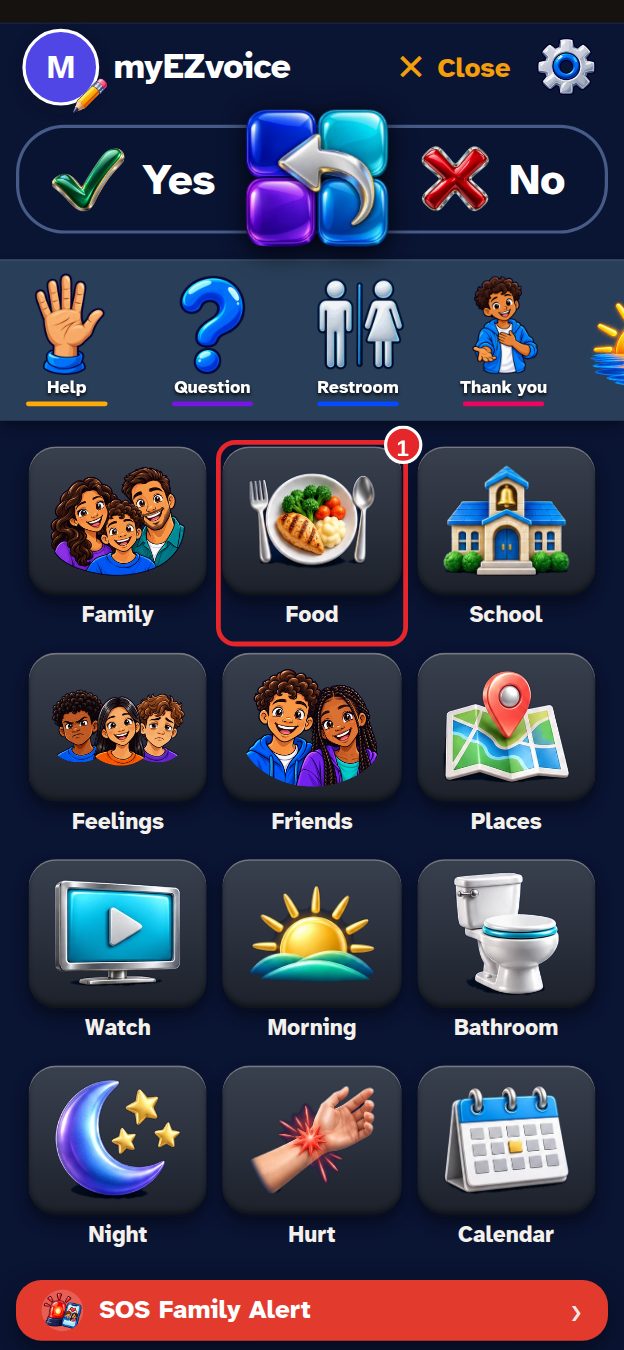
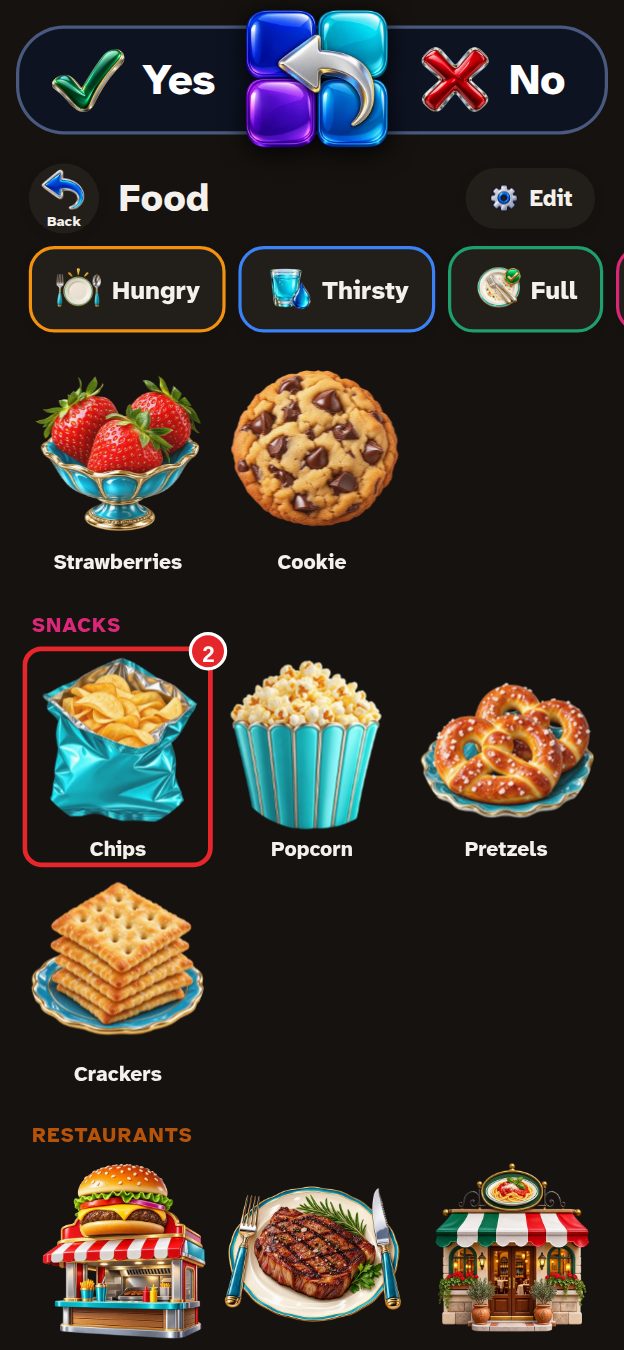
myEZvoice home, tap 1: FoodmyEZvoice Food, tap 2: ChipsmyEZvoice Chips, tap 3: Can I have chips?
myEZvoice: “Can I have chips?”, 3 taps, and the last one says the whole sentence

Why we looked

On the tablet, every sentence is built a word at a time, and a teenager’s conversation does not wait.

What we found

Talking with AAC can be ten times slower than speech, and whole stored phrases made conversation faster and made the speaker seem more competent.

How we applied it

myEZvoice puts whole everyday phrases on one button: one tap says the whole sentence. It still has a Sentence Builder for speech therapy.

  1. Building a sentence word by word is far slower than speech.

    Speech runs 150 to 250 words a minute; aided AAC is “often as low as 15-25 words per minute.”

    Limit: a 2025 paper citing a 2013 textbook, which was not itself checked.

    AAC journal 2025 Read in full

  2. Whole stored phrases made conversation faster.

    Compared with a word construction system, “Conversational rate and perceived communicative competence were both higher when the UBD was used.”

    Limit: the participants are not stated in the abstract.

    Todman et al. 2008 Official abstract

4

Visual cues and how the board is organized

EZspeak

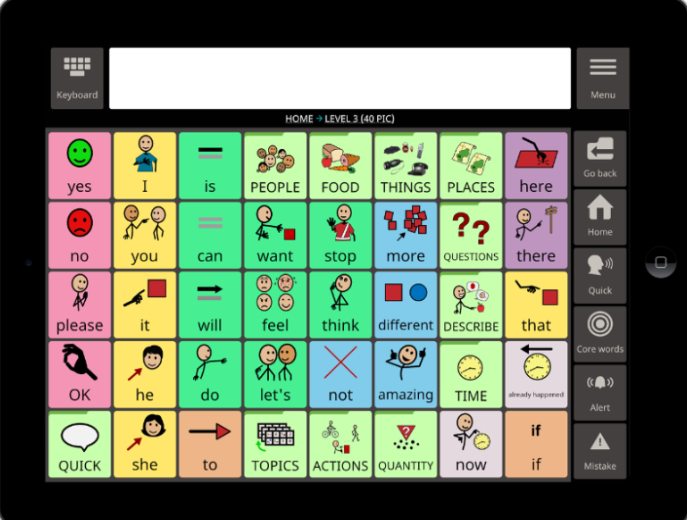
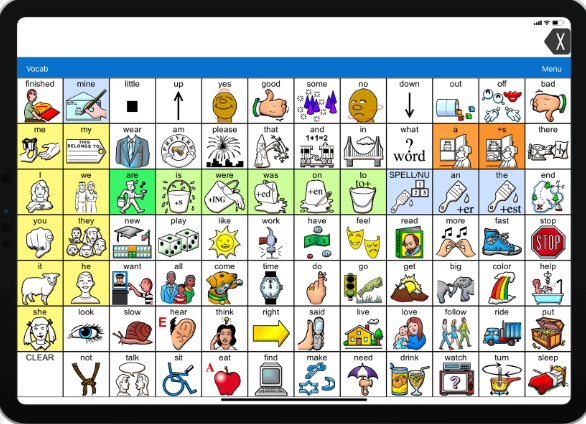
TouchChat: a grid of small symbol buttons
Today: a wall of small buttons
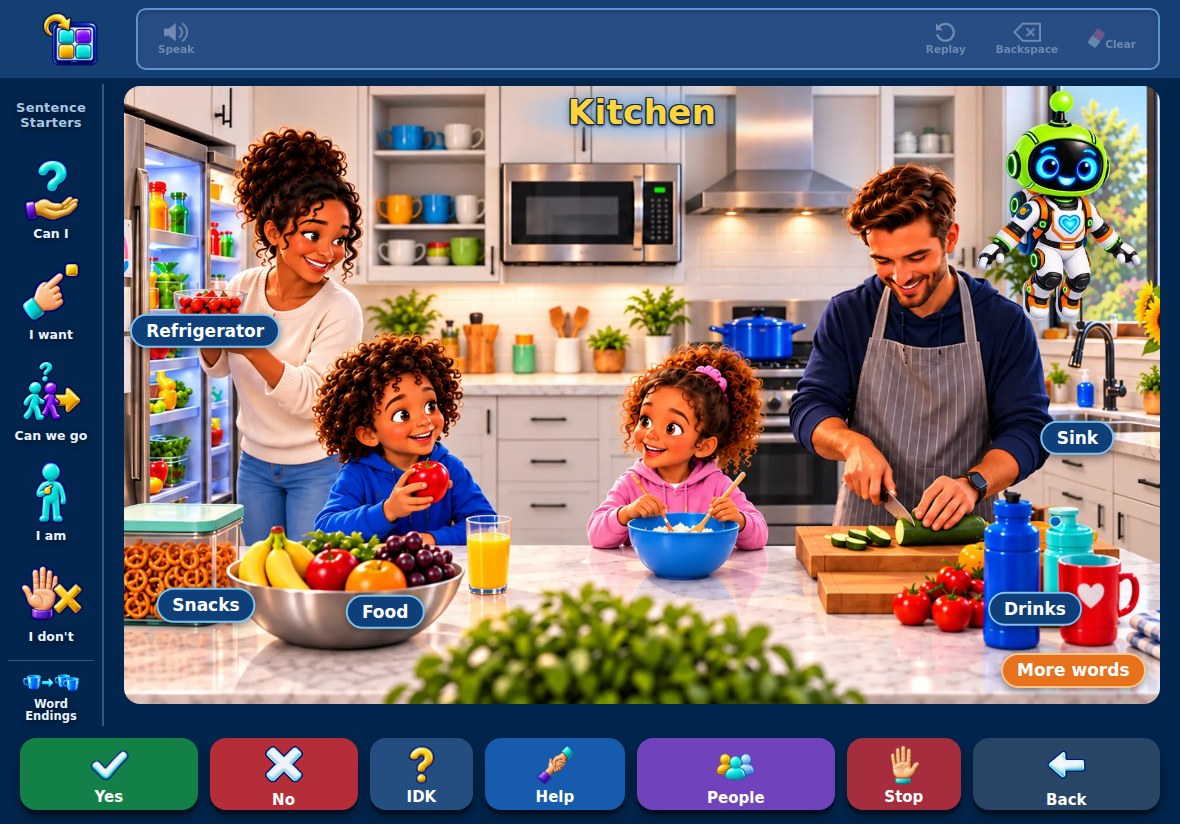
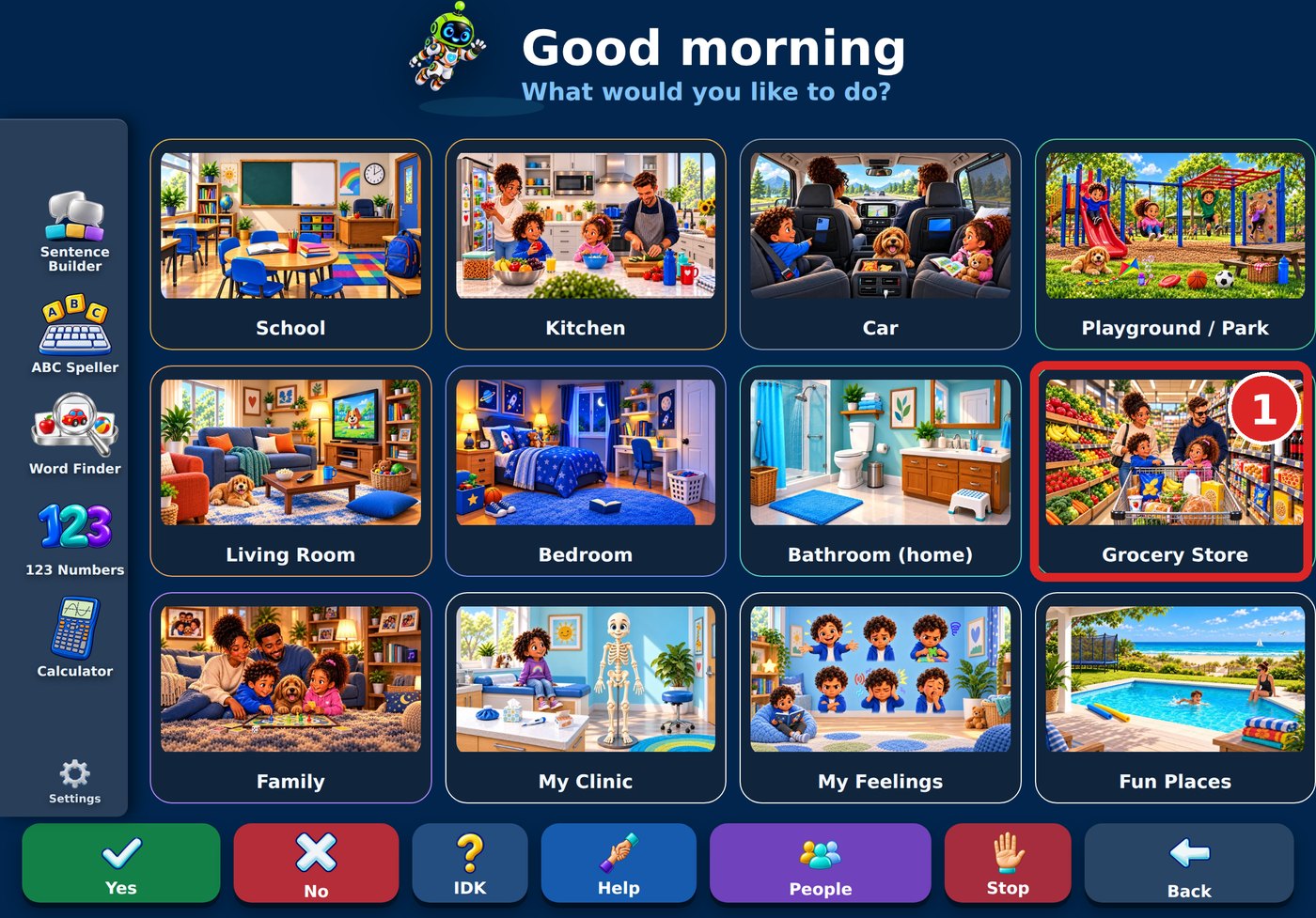
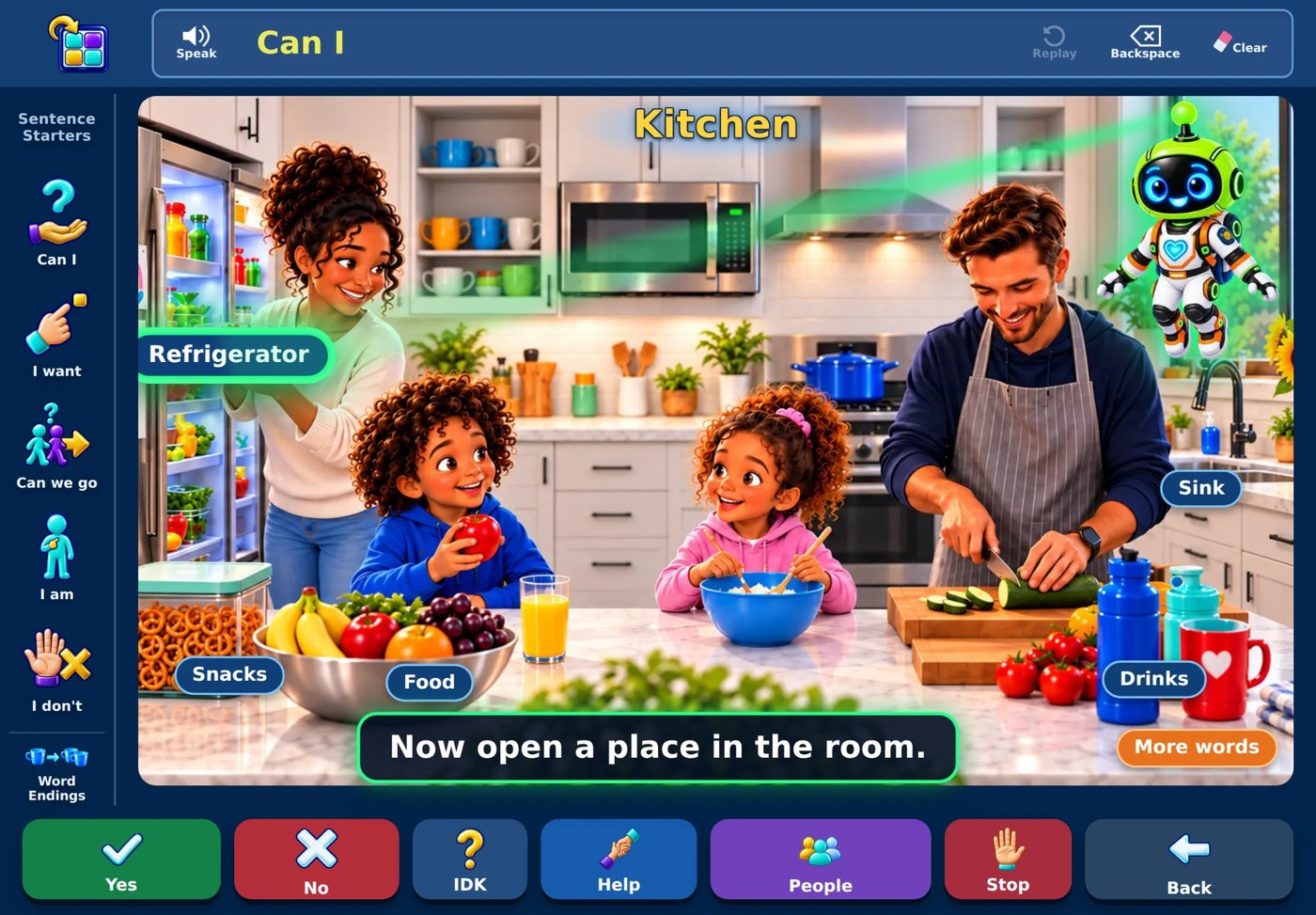
EZspeak Kitchen: a drawn kitchen with the words on the refrigerator, the sink, the snacks and the drinks
EZspeak: a room
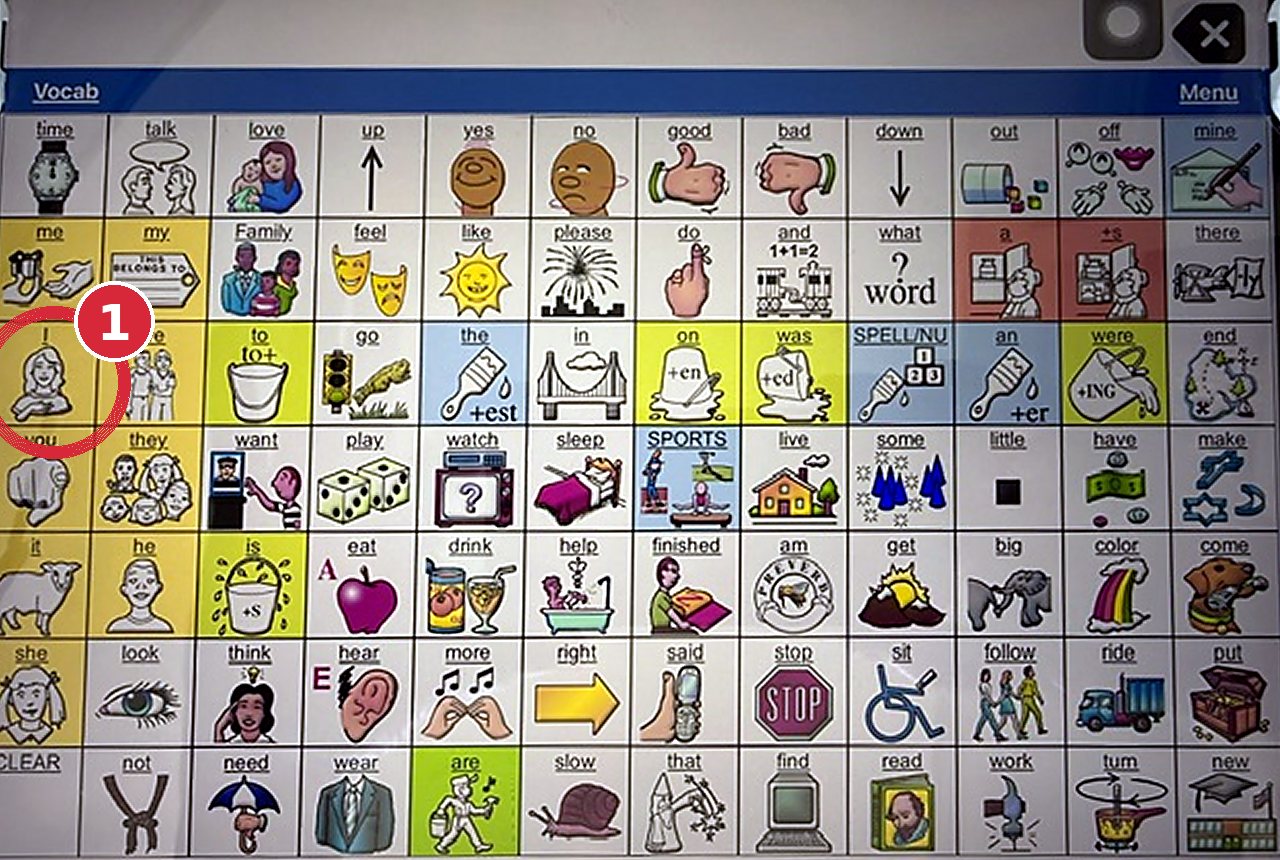
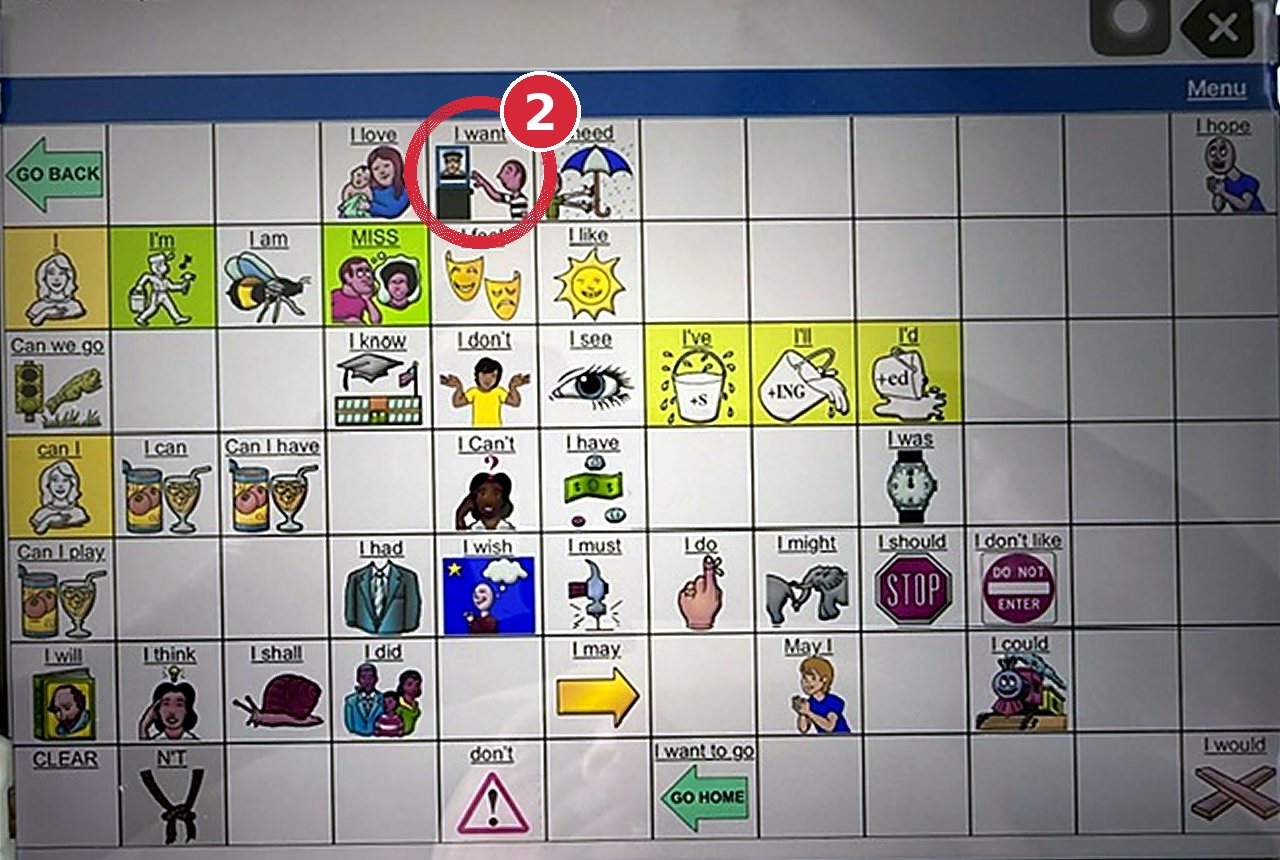
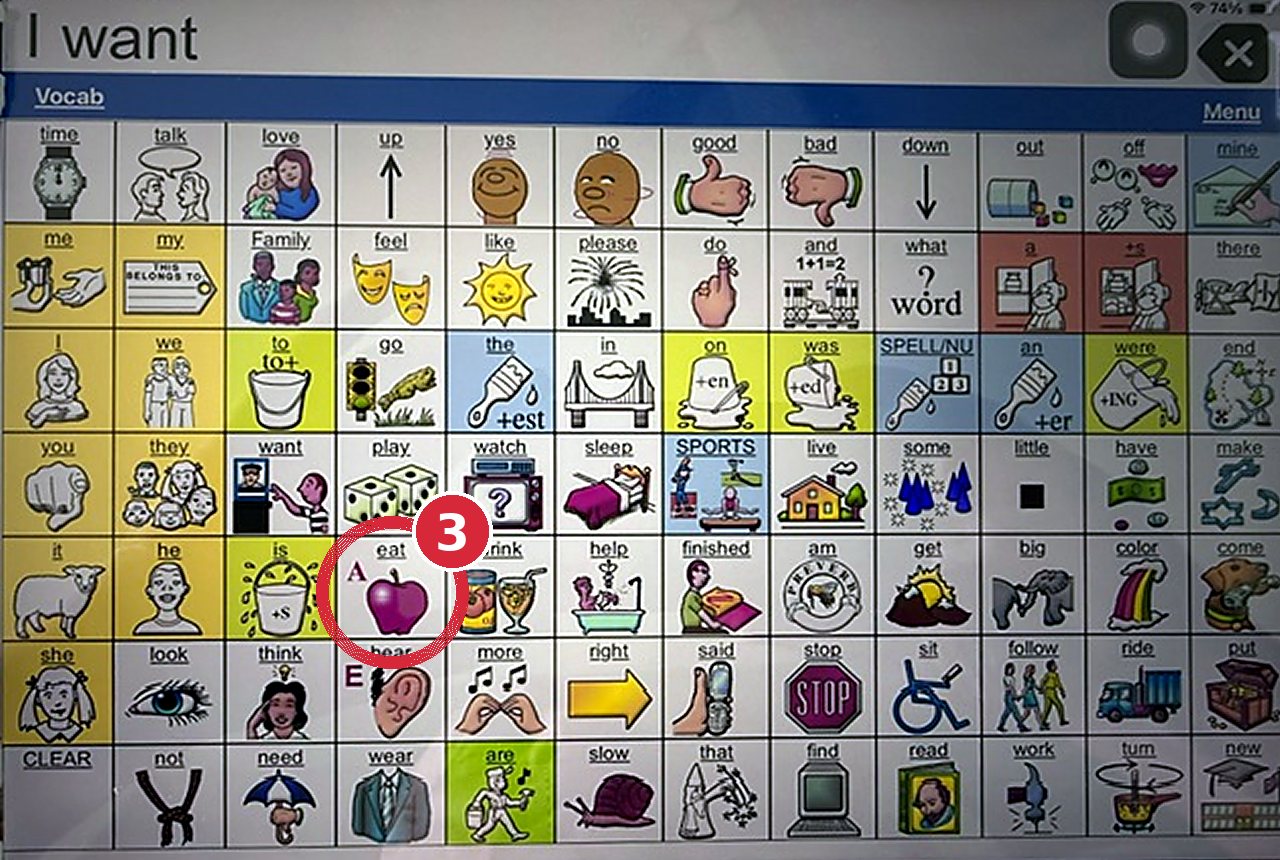
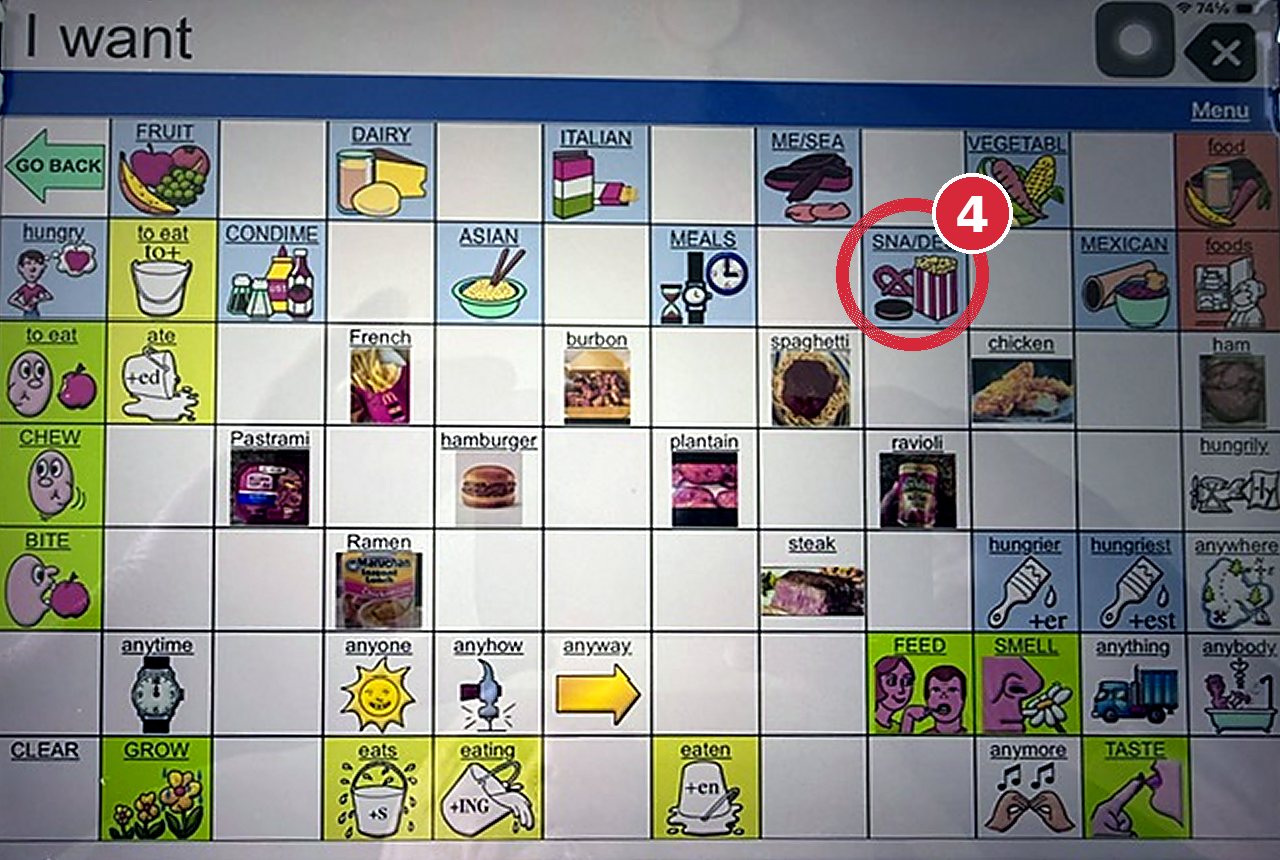
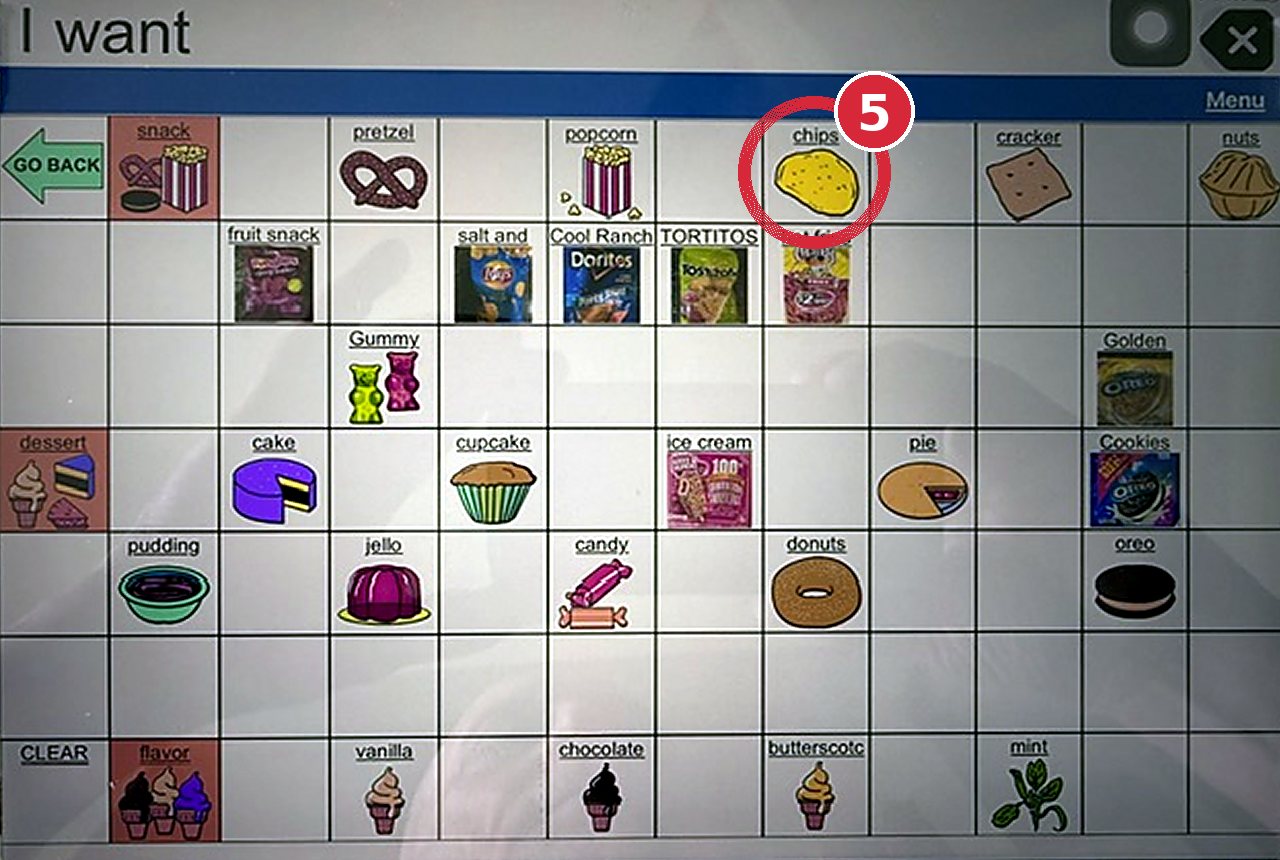
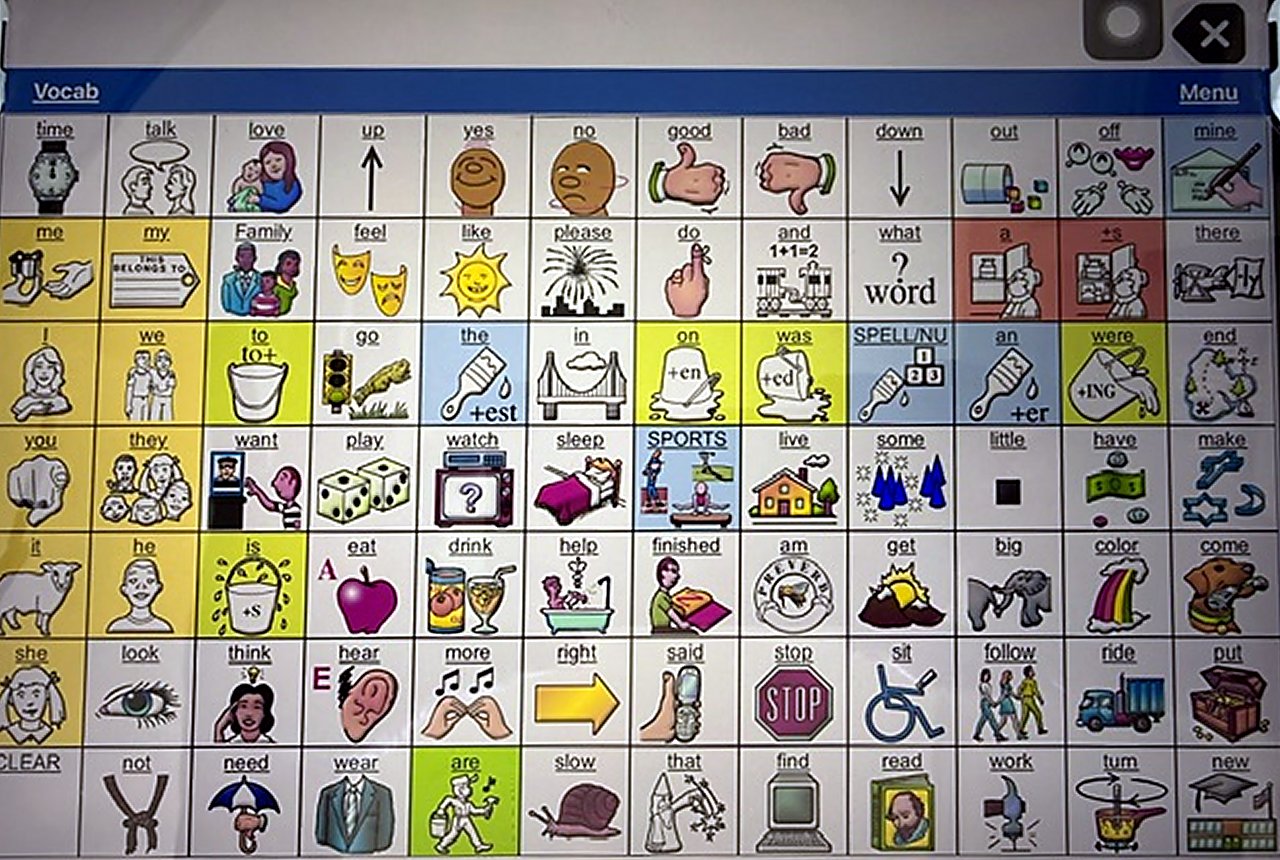
LAMP Words for Life, tap 1: ITap 2: I want, on a second screenTap 3: eat, back on the main boardTap 4: snacks, on a food screenTap 5: chips, on a snack screen
Today: “I want chips,” 5 taps, 5 screens
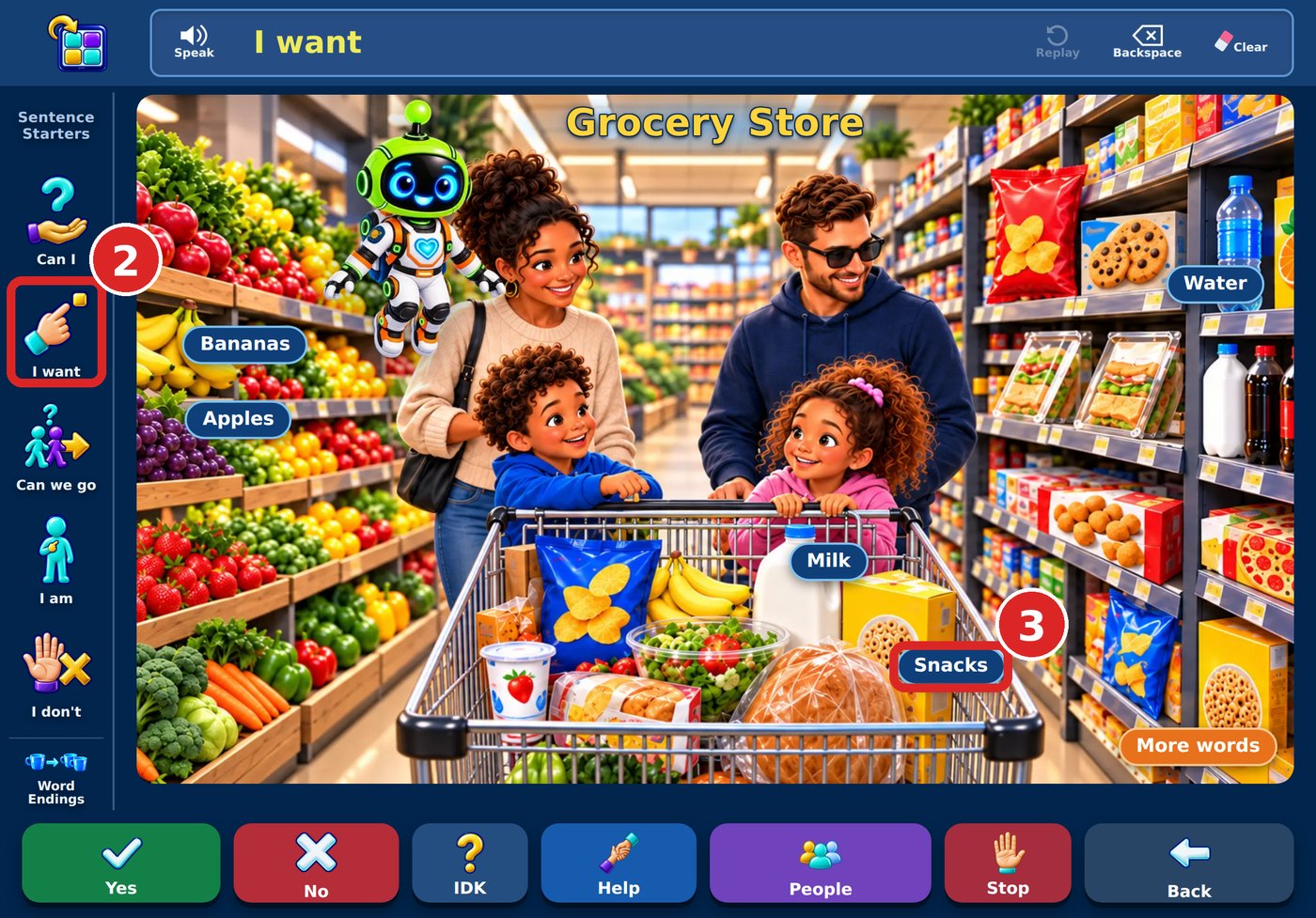
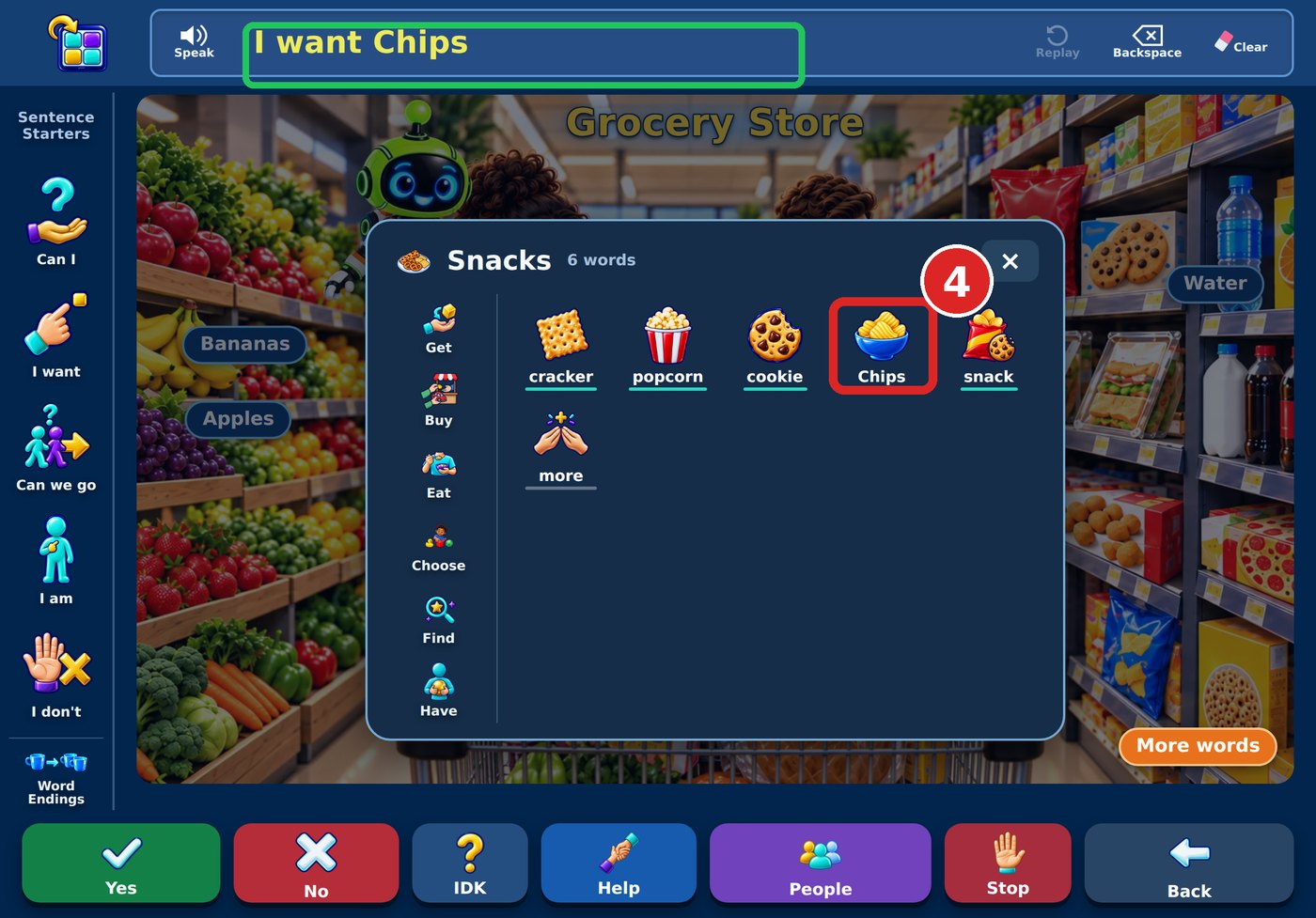
EZspeak Home, tap 1: Grocery StoreEZspeak Grocery Store, tap 2: I want, tap 3: SnacksEZspeak Snacks window, tap 4: Chips; the bar reads I want Chips
EZspeak: “I want chips,” 4 taps, 3 screens, both from the main screen

Why we looked

We asked whether the visual cues and the structure Evan grew up with were built on research. This is where the research turned us toward the younger children.

What we found

Researchers found AAC displays were built on adults’ thinking and said they should be redesigned. Drawn scenes did better than grids with young children, and pictures of real places are now called an evidence-based practice for young children. Which display design works best is still an open question.

How we applied it

EZspeak, for ages 4 and up: new visual cues drawn for it; rooms that hold the words for each daily activity; objects in the rooms that open boxes of words with the verbs along the side; and sentence starters down the left, so a child begins with a whole idea. Every room opens in levels.

  1. AAC displays were built on adults’ thinking, and researchers said to redesign them.

    “The current generation of augmentative and alternative communication (AAC) technologies is largely based on conceptual models of adults who are not disabled.” “AAC technologies should be redesigned to reduce learning demands.”

    Limit: the children studied were typically developing 2-year-olds.

    Drager et al. 2003, p. 298 Read in full

  2. Drawn rooms beat grids: 4.1 words of 12 against 1.6 and 1.9.

    After four sessions, children using a drawn scene of a house found 4.1 of 12 words on average; with the two grid layouts, 1.6 and 1.9.

    Limit: typically developing 2-year-olds, not children who use AAC.

    Drager et al. 2003, p. 304 Read in full

  3. Pictures of real places are an evidence-based practice for young children.

    12 of 14 studies met all quality indicators, with positive results for 37 of 42 participants aged 3 to 8. Visual scene displays “can be considered an EBP” (evidence-based practice) for young children with ASD/IDD.

    Limit: ages 3 to 8; 11 of the 12 interventions were run by researchers.

    Patenaude et al. 2025 Read in full

  4. Display design is still an open question.

    “Future research is required to determine whether the display variables discussed influence functional and authentic communication outcomes.” Every study it covers “presented AAC displays on computer screens.”

    Limit: a review of display features, not a test of any product.

    Light, Wilkinson et al. 2019 Read in full

  • Where the evidence stops: the drawn-room study used typically developing 2-year-olds. The studies we checked do not test sentence starters, verbs beside the words, or vocabulary that opens in levels; those are our design.
5

The adults around the child

EZspeak

LAMP Words for Life on an iPad: a grid of small single-word buttons
Today: no one on the screen to help
EZspeak Kitchen with EZbot showing the next step: Now open a place in the room
EZspeak: EZbot shows the next step

Why we looked

A board only works if the people around the child use it too, at school and at home.

What we found

Clinicians rated the adults as the top reasons devices are dropped: partners who think they understand without the device, families not trained, partners who do not model. Adults modeling on the device is “highly effective.”

How we applied it

EZbot, on the tablet. Tap “Show me” and EZbot builds a sentence step by step, each step glowing green, with sound or quietly, so a parent sees how the board is used. The parent chooses how much EZbot helps the child: Off, Glow only, or Step-by-step. A tap on EZbot also brings the words of the room and link the child is in, with the verbs beside them.

  1. The adults around the child top the reasons devices are dropped.

    Clinicians rated partners believing they understand the person without the device (77.75% of cases), “The family is not trained to operate and/or program the system” (64.52%) and “Communication partners do not model system for the user” (63.78%).

    Limit: clinicians’ estimates, not measured causes.

    Johnson et al. 2006, Table 4, p. 92 Read in full

  2. Modeling on the device is “highly effective”.

    Aided AAC input was “highly effective across participants of various ages, disabilities, and language skills,” across 26 single-case designs (88 participants) and 2 group designs (103).

    Limit: the models were people, usually combined with other strategies.

    O’Neill et al. 2018 Official abstract

  3. Modeling led to “meaningful linguistic gains”.

    Packages that include partner modeling led to “meaningful linguistic gains” in communication turns, vocabulary, multi-symbol turns and word endings, across 9 single-case studies (31 participants) and a group study (63).

    Limit: the modelers were communication partners, not software.

    Sennott et al. 2016 Official abstract

  4. Technology that teaches the adults is a recognized research line.

    A state-of-the-science review covers AAC technologies that “(e) teach interaction strategies to communication partners.”

    Limit: what the review reports on these technologies is in the body, not yet read.

    Light, McNaughton & Caron 2019 Official abstract

  • Where the evidence stops: no study found tests software, rather than a person, as the one who models on the board. Coaching apps for families already exist, so coaching alone is not new.
6

Progress over years

myEZvoiceEZspeak

LAMP Words for Life board
Today: the same screens from elementary school on
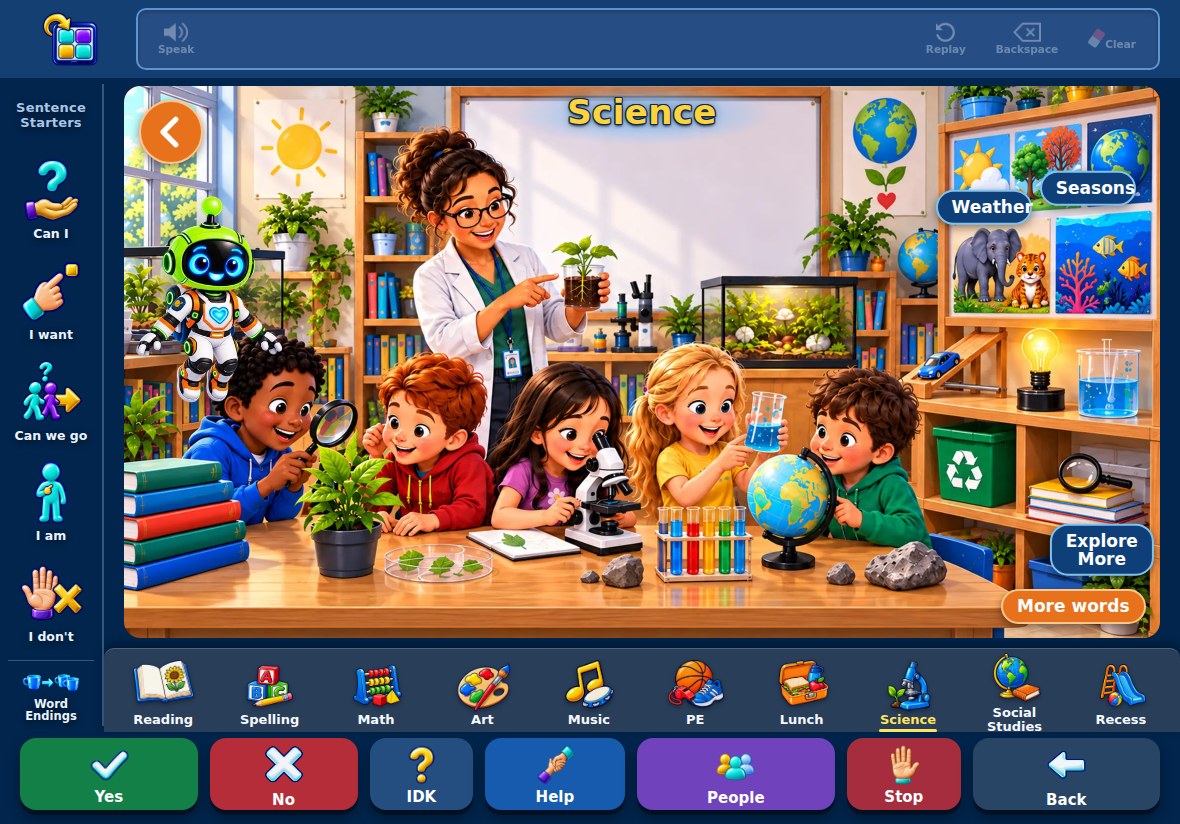
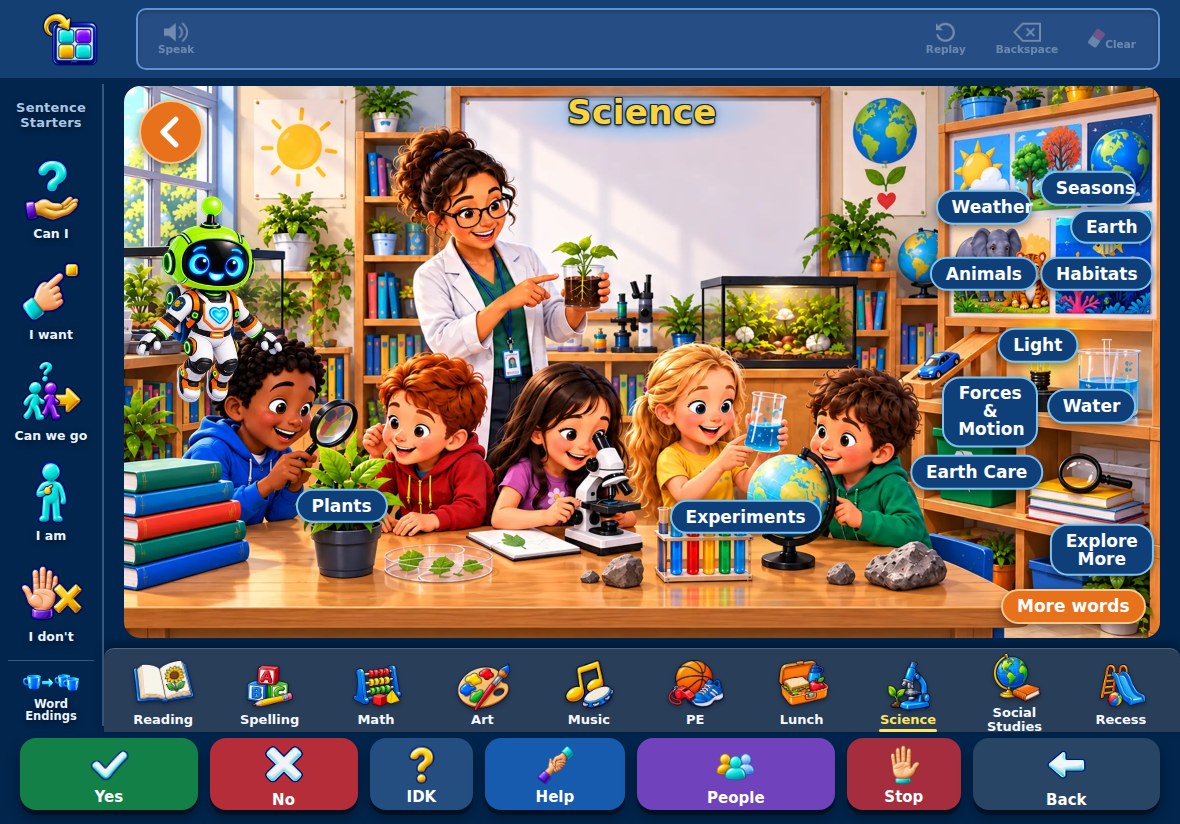
EZspeak Science room at Level 1EZspeak Science room at Level 4, with twelve links
EZspeak: Science, Level 1, then Level 4

Why we looked

A family lives with a device for years. We looked for studies that follow children that long.

What we found

No study found follows today’s AAC devices or apps for 3 years or more. The best modern trial stopped at 9 months, and gains in one trial were gone 10 months later. Clinicians estimated only 39.35% of clients succeed beyond a year, and devices are dropped most in the first year and after 5 years.

How we applied it

A board that grows with the child, on the tablet. EZbot counts the words a child uses without help and proposes the next level; an adult approves it, and nothing already on the board moves. Home rooms count toward growing; school subjects and the Sentence Builder count toward grades. This measures progress inside the app; it is not a study over years.

  1. No study found measures today’s AAC devices or apps over 3 years or more.

    The Cochrane review found only 2 randomized trials (154 children aged 32 months to 11 years), rated the evidence “very low” quality, and in the PECS trial “gains were not maintained 10 months later.” The longest outcome study found ran 2 years with 13 boys and young men aged about 6 to 20, and was published in 1996.

    Limit: “no study found” means our searches; a university library search could still find one.

    Brignell et al. 2018, Cochrane Read in full · Romski & Sevcik 1996 Official record · ages from Barker et al. 2019 Read in full

  2. The best-controlled modern speech-device trial stopped at 9 months.

    61 minimally verbal autistic children aged 5 to 8: “The study duration was 9 months (36 weeks).”

    Limit: the device was added to a 2-hour-a-week communication program, so it was not tested alone.

    Almirall, Kasari et al. 2016 Read in full

  3. Clinicians estimated 39.35% of AAC clients succeeded beyond a year.

    In a survey of AAC clinicians, 28.68% of clients were estimated to have abandoned AAC.

    Limit: clinicians’ estimates from 2006, all ages, not measured outcomes.

    Johnson et al. 2006, p. 90 Read in full

  4. Assistive devices are dropped most in the first year and after 5 years.

    29.3% of devices were “completely abandoned.” Abandonment rates “were highest during the first year and after 5 years of use.”

    Limit: a 1993 survey of 227 adults across all assistive technology, not AAC or children.

    Phillips & Zhao 1993 Official abstract

7

What has changed since the apps arrived

myEZvoiceEZspeak

Why we looked

People ask: there are already products, so why is this any different? We looked at what changed once AAC moved onto phones and tablets.

What we found

AAC came to the iPhone in April 2009. Four years later, leading researchers wrote that most AAC apps were not research-based and simply replicated the older systems, and passed on a warning about developers following the status quo.

How we applied it

We started from the research and from Evan, not from an existing board. myEZvoice is not a tablet board made smaller for a phone, and EZspeak is not a grid of small buttons.

  1. Leading researchers said most AAC apps were not research-based.

    “Most of the current AAC apps available for the iPad and other mobile technologies are not research-based; many simply replicate the approaches to representation and organization of vocabulary items seen with traditional AAC systems” (p. 113). Developers “may be tempted to follow the status quo, simply reiterating existing features in apps, rather than forging new ground” (p. 112).

    Limit: describes apps as of 2013; it does not measure what has changed since.

    McNaughton & Light 2013, pp. 112 and 113 Read in full

  2. AAC came to the iPhone in April 2009.

    Proloquo2Go was first released on the App Store on 21 April 2009, for iPhone and iPod touch, before the iPad existed.

    Limit: a first release date, not a measure of design.

    Apple App Store record Official record

8

Who needs it

myEZvoiceEZspeak

Why we looked

To know how many children and teenagers this is for.

What we found

Identified autism has risen to 1 in 31 eight-year-olds, and about 30% of autistic children are estimated to stay minimally verbal.

How we applied it

Both products are for nonverbal and minimally verbal children, teenagers and young adults: EZspeak for ages 4 and up, myEZvoice for ages 12 and up.

  1. Identified autism rose from about 1 in 150 to 1 in 31.

    CDC estimates for 8-year-olds: about 1 in 150 for 2000 data, 1 in 31 for 2022 data.

    Limit: a new case definition began with 2018 data, and the sites are not nationally representative.

    CDC MMWR, 17 April 2025 Read in full

  2. An estimated 30% of autistic children stay minimally verbal.

    “It is currently estimated that about 30% of children with autism spectrum disorder remain minimally verbal, even after receiving years of interventions and a range of educational opportunities.” A Swedish study of 165 children recruited at ages 4 to 6 found 15% nonverbal and 10% minimally verbal 2 years later, after intervention.

    Limit: definitions of minimally verbal vary across studies.

    Tager-Flusberg & Kasari 2013 Read in full · Norrelgen et al. 2015 Official abstract

9

Spanish, and which Spanish

myEZvoiceEZspeak

SpainUSLatin AmericanMexican
Today: the Spanish they name
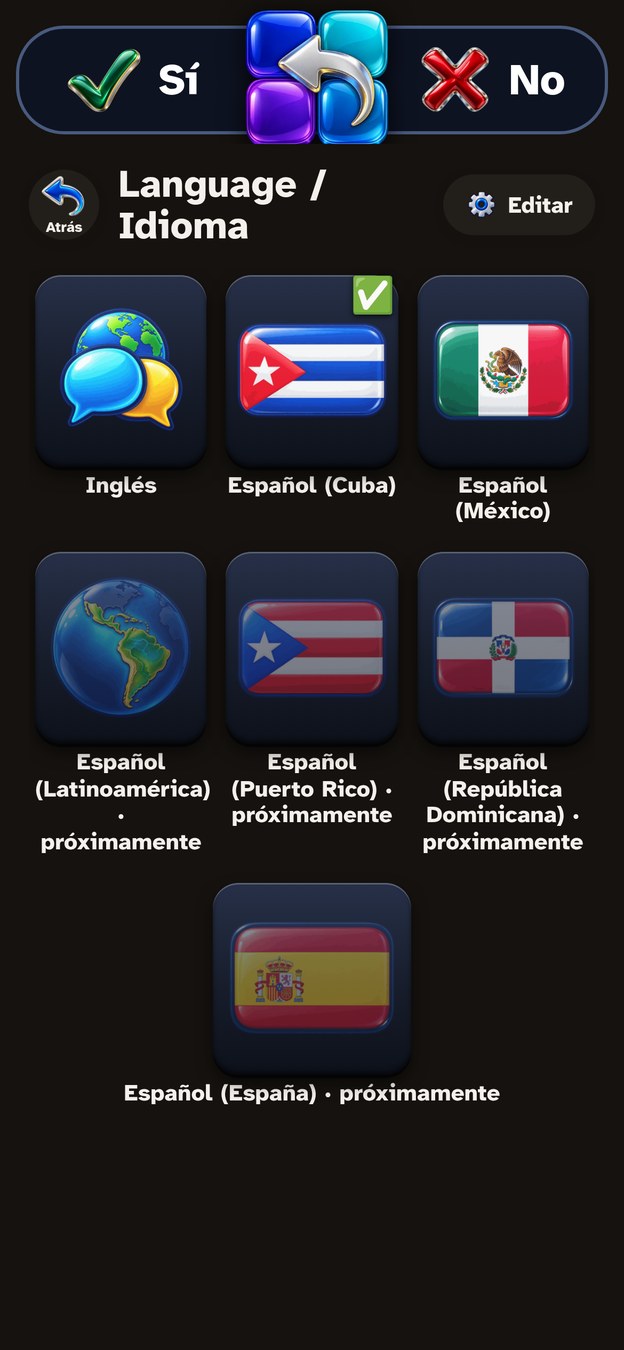
myEZvoice Language / Idioma set to Spanish (Cuba): a picture for each choice, English, Cuba and Mexico, with Latin American, Puerto Rican, Dominican and Spain Spanish coming
myEZvoice: pick the family’s Spanish

Why we looked

Mexican, Puerto Rican, Dominican and Cuban Spanish use different words for the same thing. We wanted to know whether the AAC in use today lets a child speak the Spanish of their own family.

What we found

Of 18 AAC products checked, 9 confirm Spanish. The Spanish they name is Spain, US, Latin American or Mexican. None offers Puerto Rican, Dominican or Cuban Spanish, though voices for all three exist. Research with Spanish-speaking families matches the vocabulary to the family’s dialect by hand.

How we applied it

Spanish in both products. On the tablet, Spanish words and the dialect setting for Mexican, Puerto Rican, Dominican and Cuban Spanish are live. On the phone, Cuban and Mexican Spanish are in testing in the newest build (13 Oct 2026), with Latin American, Puerto Rican, Dominican and Spain Spanish to follow. Recorded Cuban and Mexican voices are in progress, and every Spanish line is reviewed by native speakers before it is final.

  1. The most specific Spanish an AAC maker names is Mexican.

    LAMP Words for Life lists “English (US), German, Spanish (Mexico), and French (Canada) vocabulary files.” TD Snap Core First offers “Spanish (LA/MX)”. Proloquo2Go lets you “select a language and region”; its Spanish has been described as Castilian and North American.

    Limit: a “Spanish (Mexico)” vocabulary does not show which accent the voice has.

    LAMP Words for Life, App Store Official record · Proloquo2Go, App Store Official record · Tobii Dynavox TD Snap page Official record

  2. No Puerto Rican, Dominican or Cuban option was found in any AAC product.

    18 product families checked, 9 with Spanish confirmed from the maker or the App Store. The varieties named: Spain or Castilian, US or North American, Latin American, Mexican.

    Limit: “not found” means our searches; some makers’ sites could not be opened, and only the US App Store was checked.

    Our searches, 12 Oct 2026 (brain: research_notes/Spanish AAC dialects)

  3. The voices exist; AAC has not used them.

    Microsoft’s speech service lists Spanish (Puerto Rico), Spanish (Dominican Republic) and Spanish (Cuba), two voices each.

    Limit: adult voices; the only Spanish child voice listed is Mexican.

    Microsoft speech service language list Official record

  4. Researchers match the vocabulary to the family’s dialect.

    Children used “iPad minis with the Proloquo2Go communication app,” and “vocabulary matched the family’s dialect and vocabulary preferences.” The families came from Mexico, Cuba and Venezuela.

    Limit: a small study; the matching was done by the researchers, not built into the app.

    Pak et al. 2025 Read in full

  5. Users notice when the Spanish is not theirs.

    “The options were Mexican or Spain Spanish, and none of them sounded like anyone he knew.” A respondent: “Las voces en español, son de España y no latinas” (the Spanish voices are from Spain, not Latin America).

    Limit: a preprint, not yet peer reviewed.

    Weinberg et al. 2026 Read in full

  6. In the US, the Spanish is mostly Mexican, then Puerto Rican, Cuban and Dominican.

    “The roughly 40 million people of Mexican origin in the U.S. represented 57% of the nation’s Hispanic population in 2024. At 6.1 million, people of Puerto Rican origin are the next largest group.” Cubans, Salvadorans, Dominicans, Guatemalans, Colombians, Hondurans, Venezuelans and Ecuadorians each number 1 million or more.

    Limit: origin is self-described, and not every Hispanic family speaks Spanish at home (68% did in 2024).

    Pew Research Center, 22 Oct 2025 Read in full

  • Where the evidence stops: no published first-words list was found for Puerto Rican, Dominican or Cuban children; Wordbank holds Spanish lists for Mexico, Spain, Peru, Argentina and Chile only.

How far each item was checked: Read in full the whole paper or record was read. Official abstract checked against the official abstract (PubMed, Crossref or ERIC). Official record checked against the official catalogue or store record.

Checked 12 October 2026. “No study found” means our searches did not turn one up; it does not prove none exists. Product facts are the products’ own, as they run today. Product names are their owners’ trademarks.